Posts

Showing posts with the label Ashanti

El Anatsui: 2013 Brooklyn Museum Retrospective

Image
"Gli" (Wall), 2010, at the beginning of the exhibition area, Brooklyn Museum What a life trajectory. El Anatsui's work is now featured in a retrospective at one of the United States' premier museums, the Brooklyn Museum :  Gravity and Grace: Monumental Works by El Anatsui , curated by Kevin Dumouchelle. El Anatsui has been shown at New York City's contemporary African art galleries since over 20 years, such as Skoto Gallery and the  Contemporary African Art  gallery. The first pieces I had seen, in the 1990s, and admired, were made of wood, and I still have a Newark Museum postcard I held on to since 2007. Several years ago, both Skoto Gallery and the Contemporary African Art Gallery staged a double exhibit of El Anatsui's new metal work, which is the art that finally made him famous worldwide, at the age of sixty! "Amewo" (People) - 1998, modified 2010 The art  was so wonderful to behold that we all wanted a piece, even though none of ...
Welcome to the (African) Dollhouse

Image
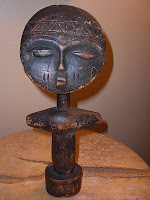
In "the olden days," in Sub-Saharan Africa, there was a larger variety of dolls than nowadays, of which I'll describe a few. They used to be made of natural materials, such as wood, earth, or even weeds. Ashanti doll The Ashanti doll, from Ghana , is one of the most famous worldwide:   a wood circle-face on a stick-like body (photo shown to the left) Moundang doll The Mandara mountains Moundang doll, from Northern Cameroon , made of volcanic rock, and decorated with tiny beads. This is the one which arguably least resembles the traditional European-style doll (photo right).  Fali dolls from northern Cameroon :   * male doll made of a corncob, decorated with  cowry  shells, European beads, leather strips, with a cotton skirt;   * "boy" doll made of wood, with cowry shells, bells, leather strips (illustrations shown below);  The Fali-Namchi dolls have been revisited in recent years, as shown below ...