Posts

Baa, baa, black sheep...

Image
Sheep, gentle and meek not only in reputation! (Link to Cameroon sheep photo here ) Barely a few months into my life in Cameroon, we went on a road trip to West Cameroon to see a business connection.  Nkongsamba is one of the Littoral Province's larger towns, a commercial hub, about two hours' drive on the way  to West Cameroon, from Douala, where we lived.There we stopped for lunch at a local small hotel. I ordered roast chicken which seemed safe and familiar. When the chicken was served, I tried to dig in--unsuccessfully. The chicken was as tough as leather. Little did I understand the reality of "poulet bicyclette" (bicycle chicken), i.e. chickens that were never fed anything, and had to fend for themselves, often pecking on dirt and running around all day, till they approach Lance Armstrong's musculature. I had to wait a couple of years till my American friend started a chicken farm to have tender chicken. That was that for lunch on that day! We con...

Bibi Seck, Industrial Designer in New York City

Image
Ayse,  Bibi, and daughters  Bibi Seck is an industrial and product designer of Senegalese and Martiniquais descent,  introduced from afar by Fatimata Ly, a Senegalese ceramics designer I wrote about last year. As a matter of fact, I had been hearing about him and his spouse, Ayse Birsel, for a while already: the New York African design community is not that large, and especially an African married to a fellow Middle Easterner (Turks are Middle Easterners as well as Europeans, with literally a foot in both worlds; and of course we had the Ottoman Empire for six centuries!). Moroso-M'Afrique collection Bibi’s stools, made in Senegal, of recycled plastic, are currently exhibited at the Museum of Art and Design’s Global Africa show. I interviewed him last week to find out what his path had been to this point. Bibi was raised between Europe and Senegal.He had planned on studying architecture at first, but then found his true vocation in Industrial D...

Cassava, a multi-function edible root; making Gari

Image
Cassava is known in French as Manioc , and here in the United States often as Yuca . It seems it originated in South America, but it is widely grown in equatorial Africa. In Cameroon it is a staple, and the most common and popular use is Gari, a sort of coarse tapioca; mixed with water, sugar and peanuts to make a filling snack or meal. In fact, the way most Europeans know Cassava is through tapioca pudding! A field was planted by a friend in Abo, Littoral region, two years ago, and finally the cassava roots were harvested in November/December  2010 (a warm and dry time of the year). Our very trusted friend Guérin supervised and participated in the harvest and the making of Gari from beginning to end, and sent us photographs of the process. Cassava in the field Cassava and bags transported to the main road (left to right) Piling cassava roots at loading area; filling the truck; unloading Peeling the roots; the drying area; putting the peeled roots into bag...

Vickie Frémont, New York - Africa: artist and designer

Image
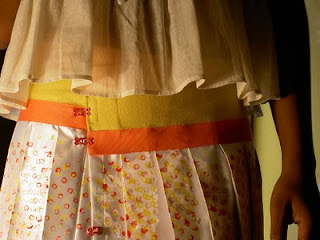
Vickie Frémont Vickie Frémont has been designing and creating since she was 8 years old, drawing and painting without having ever been taught. At the age of 12 she began to sew, making dolls for her little sister. She was rather shy and spent most of her time as a child alone, reading, writing or knitting, beading… Vickie was born in Cameroon, but left at an early age. With her parents, she lived in Morocco, and many years in the Ivory Coast and in France. She obtained a Bachelor’s degree, in France, and planned to teach Spanish. She also studied anthropology and economics. However, at one point she was working in the neighborhood of the Necklaces Beaux Arts (fine arts) school and started studying Arts techniques, realizing that there was her calling. She operated a knit textile company for several years, employing 10 people, creating knit designs for such well-known brands as Georges Picaud, Anny Blatt, Pingouin, Phildar, Sonia Rykiel, Torrente, Dorothée Bis, Daniel Hetc...

Traditional and Contemporary Dress from Africa

Image
In May 2010, there was a photo in the media of South African President Zuma wearing leopard skin at a wedding. The photo prompted a discussion on whether Africans should show the rest of the world themselves in traditional dress, or wearing European clothes in order to "blend in" with the rest of the world, as many Westerners have an unfavorable idea of African tradition. In my view, this would be an error. The problems in Africa do not have anything to do with their traditional ways of dressing. As a matter of fact, some of the leaders one only sees wearing suits and ties are in fact the worst and the  most corrupt. Photo courtesy Sakina M'sa To be frank, some ways of dressing may not be the most practical for going to the office; and I have nothing against anyone wearing the latest designs, especially as nowadays there are also many designers of African descent, albeit more in the realm of women's clothing than men's attire. To cite a few: Alphadi , Saki...

Jerry Vogel, Africa Veteran Extraordinaire

Image
November 2014: Mr. Jerome Vogel passed away peacefully on September 10, 2014, of an apparent heart attack. May he rest in peace. The below post was originally published July 25, 2014. Jerry Vogel was getting ready to leave for  Mali , to take a group of students from all over the  United States  on a tour. He’s been traveling throughout Sub-Saharan Africa since the 1960s. Having arrived for the first time in  Cameroon  fifteen years later, I was eager to hear of his impressions from those post-independence years. Above: to the right, a Cameroonian Calebasse Jerry Vogel is a born and bred New Yorker: he lived in the Bronx , until he left for Hamilton College . He received a Fulbright Scholarship to study for a year in France . After completing graduate studies in English Literature, he taught at Georgetown University for five years, when he applied for a teaching position at the university in Abidjan , Ivory Coast . At that point he knew not...

Talented artists in Cameroon

Image
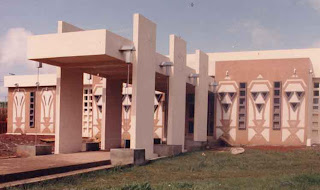
W hen we were living in Cameroon, we often worked with people from the family circle and the neighborhood, but at other times, we also had the pleasure of collaborating with talented people we met by coincidence.  As architects, we worked on a variety of projects. One of them was the renovation of a university restaurant in West Cameroon, in the Grassland region.   The original building was from the Soviet-era, in a rather "squarish" architectural style. Epee Ellong, a Cameroonian architect, was able to "Africanize" it by adding mosaic panels on the exterior walls.  As for the inside, there were large empty walls, so we suggested that a modern artist come and decorate them with frescoes. We thought of  Koko Komegne , whom we had met a short time before; he assured us that large-scale frescoes would not pose a problem. As it turned out--we didn't know this before Koko won the bid--Koko is from the same area the building was located in, so he was espe...