Posts

Jerry Vogel, Africa Veteran Extraordinaire

Image
November 2014: Mr. Jerome Vogel passed away peacefully on September 10, 2014, of an apparent heart attack. May he rest in peace. The below post was originally published July 25, 2014. Jerry Vogel was getting ready to leave for  Mali , to take a group of students from all over the  United States  on a tour. He’s been traveling throughout Sub-Saharan Africa since the 1960s. Having arrived for the first time in  Cameroon  fifteen years later, I was eager to hear of his impressions from those post-independence years. Above: to the right, a Cameroonian Calebasse Jerry Vogel is a born and bred New Yorker: he lived in the Bronx , until he left for Hamilton College . He received a Fulbright Scholarship to study for a year in France . After completing graduate studies in English Literature, he taught at Georgetown University for five years, when he applied for a teaching position at the university in Abidjan , Ivory Coast . At that point he knew not...
Talented artists in Cameroon

Image
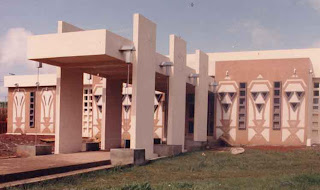
W hen we were living in Cameroon, we often worked with people from the family circle and the neighborhood, but at other times, we also had the pleasure of collaborating with talented people we met by coincidence.  As architects, we worked on a variety of projects. One of them was the renovation of a university restaurant in West Cameroon, in the Grassland region.   The original building was from the Soviet-era, in a rather "squarish" architectural style. Epee Ellong, a Cameroonian architect, was able to "Africanize" it by adding mosaic panels on the exterior walls.  As for the inside, there were large empty walls, so we suggested that a modern artist come and decorate them with frescoes. We thought of  Koko Komegne , whom we had met a short time before; he assured us that large-scale frescoes would not pose a problem. As it turned out--we didn't know this before Koko won the bid--Koko is from the same area the building was located in, so he was espe...

Uncle Dibounjé, family celebrity

Image
Uncle Dibounjé was one of the first non-immediate family members my spouse introduced me to upon my first visit to Douala. Uncle Dibounjé was otherwise known as Chief Dibounjé Cain Toukourou, the traditional chief of Bonendalé , a village about 20 km away from Douala over a bumpy road, crossing the bridge towards West Cameroon. My spouse's relationship to him was through his paternal grandmother. Not exactly close blood ties, but my spouse and Uncle Dibounjé had been close on an intellectual level for many years. At the time, his grandchildren were all very young, but now we are in constant contact with his eldest grandson, who lives in France. When I asked him whether I could write about his grandfather, and use the photo I had available, he answered: "Why are you asking me? Do whatever you want: he's your family too." Uncle Dibounjé was a local celebrity. In fact, he was one the the subjects of a book written by a French Jesuit priest, Père Eric de Rosny , who ...

Sculpting the stool

Image
A fricans made metal tools by sharpening them with stone instruments, before they started using European-style hoes and specialized tools. Stools were mainly found in forest areas, because of the availability of large blocks of wood.   Traditionally, a person would put in an order for a custom stool with a professional sculptor, who would make it out of a block of wood. First the wood had to be hollowed out with a hoe, called a d ibao . The sculptor would use a controlled fire (using hulls of palm nuts, or banana leaves) within the wood, to soften it in order to be able to hollow it out, in a similar way as used when making a  pirogue . The sketch shows the way the stool was sculpted, along with the photo of a finished stool. Before the stool was finalized, the client would sit on it to ensure that the height and width were comfortable. The formed stool was then sculpted with symbols, names... Before the use of sandpaper, leaves of a plant na...

Recipe: Okra stew, adapted

Image
This is an adaptation of okra stew for Western kitchens. Okra is called "gombo" in Duala language (like "Gumbo" in the United States; the word arrived with the African slaves that were brought to the country). Fresh raw okra Ingredients Smoked turkey (drumsticks or wings) OR beef for stew   Onions, chopped Canned tomatoes (crushed) Bouillon cube 1-2 tbsp natural peanut butter (for example from health food store) with no added sugar Okra (fresh or frozen) – chopped, cap removed Salt/pepper If desired , scotch bonnet hot pepper, preferably red     Sauté chopped onions; add turkey or beef cut in pieces. Add chopped okra (part can be put in a blender with the tomatoes if preferred), crumbled bouillon cube, salt (not too much because of the bouillon cube and possibly salt in the turkey and peanut butter), pepper and some water; dilute peanut butter with some water and add to pot. Add hot pepper (whole) if desired. Cook over medium heat (after liqui...

African Stools

Image
  T he most important piece of furniture in an African household is the seat, most often a stool or bench, as it is called in French:  le banc .    The  Duala  of the area now known as  Cameroon , for example, believed that the owner’s mystical strength lay in his seat; it was therefore dangerous for another person to sit on it. This person could be hit by lightning if he did not possess a similar mystical force. To sit on another person’s seat was to openly defy him, and nobody was surprised to find the transgressor dead the next day.   In  Ghana , an  Ashanti ’s seat would be tipped to one side when its owner was absent, to ensure it would not be used in his absence.   These backless seats were also used as thrones, albeit very ornately sculpted. A throne was not sufficient to make a king: the officials of the kingdom, who had assisted at the death and the burial of the previous king, were the only ones en...

Welcome to the (African) Dollhouse

Image
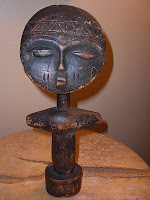
In "the olden days," in Sub-Saharan Africa, there was a larger variety of dolls than nowadays, of which I'll describe a few. They used to be made of natural materials, such as wood, earth, or even weeds. Ashanti doll The Ashanti doll, from Ghana , is one of the most famous worldwide:   a wood circle-face on a stick-like body (photo shown to the left) Moundang doll The Mandara mountains Moundang doll, from Northern Cameroon , made of volcanic rock, and decorated with tiny beads. This is the one which arguably least resembles the traditional European-style doll (photo right).  Fali dolls from northern Cameroon :   * male doll made of a corncob, decorated with  cowry  shells, European beads, leather strips, with a cotton skirt;   * "boy" doll made of wood, with cowry shells, bells, leather strips (illustrations shown below);  The Fali-Namchi dolls have been revisited in recent years, as shown below ...