Posts

Recipe: Okra stew, adapted

Image
This is an adaptation of okra stew for Western kitchens. Okra is called "gombo" in Duala language (like "Gumbo" in the United States; the word arrived with the African slaves that were brought to the country). Fresh raw okra Ingredients Smoked turkey (drumsticks or wings) OR beef for stew   Onions, chopped Canned tomatoes (crushed) Bouillon cube 1-2 tbsp natural peanut butter (for example from health food store) with no added sugar Okra (fresh or frozen) – chopped, cap removed Salt/pepper If desired , scotch bonnet hot pepper, preferably red     Sauté chopped onions; add turkey or beef cut in pieces. Add chopped okra (part can be put in a blender with the tomatoes if preferred), crumbled bouillon cube, salt (not too much because of the bouillon cube and possibly salt in the turkey and peanut butter), pepper and some water; dilute peanut butter with some water and add to pot. Add hot pepper (whole) if desired. Cook over medium heat (after liqui...

African Stools

Image
  T he most important piece of furniture in an African household is the seat, most often a stool or bench, as it is called in French:  le banc .    The  Duala  of the area now known as  Cameroon , for example, believed that the owner’s mystical strength lay in his seat; it was therefore dangerous for another person to sit on it. This person could be hit by lightning if he did not possess a similar mystical force. To sit on another person’s seat was to openly defy him, and nobody was surprised to find the transgressor dead the next day.   In  Ghana , an  Ashanti ’s seat would be tipped to one side when its owner was absent, to ensure it would not be used in his absence.   These backless seats were also used as thrones, albeit very ornately sculpted. A throne was not sufficient to make a king: the officials of the kingdom, who had assisted at the death and the burial of the previous king, were the only ones en...

Welcome to the (African) Dollhouse

Image
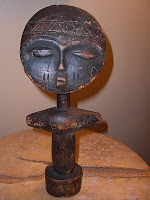
In "the olden days," in Sub-Saharan Africa, there was a larger variety of dolls than nowadays, of which I'll describe a few. They used to be made of natural materials, such as wood, earth, or even weeds. Ashanti doll The Ashanti doll, from Ghana , is one of the most famous worldwide:   a wood circle-face on a stick-like body (photo shown to the left) Moundang doll The Mandara mountains Moundang doll, from Northern Cameroon , made of volcanic rock, and decorated with tiny beads. This is the one which arguably least resembles the traditional European-style doll (photo right).  Fali dolls from northern Cameroon :   * male doll made of a corncob, decorated with  cowry  shells, European beads, leather strips, with a cotton skirt;   * "boy" doll made of wood, with cowry shells, bells, leather strips (illustrations shown below);  The Fali-Namchi dolls have been revisited in recent years, as shown below ...

How to Save Money: Cameroon Tontines

Image
In various parts of Africa, there are informal organizations, called "tontine," in French-speaking Cameroon. I looked up “tontine” in the English-language Wikipedia , and the definition is not the same; however, there is a link to the word “ likelamba ,” which describes the everyday African tontine. Two types of tontines The usual system is that all the members of a tontine—usually tontines are all-male or all-female—contribute a set amount of money every month to a common “pot,” and every month a different person takes the entire sum, usually to take care of a large expense they couldn't otherwise afford: tuition for a child, household equipment, etc. It is very difficult to save money in Sub-Saharan Africa for all but a fortunate few. Everyday needs are pressing, and there is never enough money; even if there is, a family member may have an urgent need, and there goes any money that was left over! In Cameroon, there is yet another tontine system, called the ...

Our Daily Bread (or Plantain)

Image
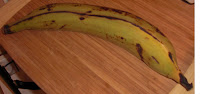
In earlier blog posts , I wrote about the variety of Cameroonian food. In this post, I'll delve into the daily life of the household in Douala, and the efforts put into getting a meal on the table. Douala is situated 4 degrees north of the equator, near the coast, at the estuary of the Wouri River. The climate is tropical. Humidity is extremely high and temperatures are most often in the 90-degree Fahrenheit range (30 Celsius). Plantain There is a rainy season that lasts about two months every year, when it gets slightly cooler (in 12 years I managed once to wear stockings, not really because I needed to), but humidity goes through the roof, and it can pour nonstop for several days in a row. In the first months, I used to go to the food market several times a week to buy groceries. Deido market was the closest (Deido is the Douala neighborhood where we lived, and my husband's ancestral home). It was not a very large market, but you could get everything you needed fo...

Ma Emilia, our Bankon (Abo) grandmother

Image
Ma Emilia was my spouse's maternal grandmother. Unfortunately, I did not get to know his paternal grandmother, as she died when my husband was a teenager. I did, however, have the good fortune to spend many years with Mama Emilia. Emilia was from Abo, a group of villages in the Littoral region. The Abos are of a similar ethnicity as the Dualas. Unfortunately, it was very difficult to get there, and in 12 years, I never visited. She spoke Abo, Duala, and Pidgin English, but no French or English. We communicated through sign language and translators, until I learned enough Duala to get by. She was raised in the village of Besunkan, in the Abo region, and moved to the village of Banseng when she married. Her husband spoke fluent German; at the time, Cameroon was a German colony. After WW I, Germany, having lost the war, also lost its colonies, and the French took over Cameroon as part of their mandate. Those Cameroonians who spoke German were not dealt with tenderly, speaki...

The dead are not dead (Part 2)

Image
From time to time, my posts will feature a person who is not with us any longer. This is not meant to be morbid, quite the contrary. I write about them because they are alive in my memory, and because otherwise, they may be forgotten. Of course, I'll be writing about those I remember with affection. We still laugh out loud thinking of my father-in-law's expressions, and imagine what his reaction would be to some of the new configurations in the family. Love lives on, all over the world.